Before video game systems took over home entertainment, arcade games were the main destinations for digital fun where players would lose their quarters faster than a kid could earn their allowance. These places used the newest technology to create games that amazed the players and tested their skills while providing lots of fun. Let’s take a look at the arcade classics.
Table of Contents
- 1 1. Pac-Man Fever
- 2 2. Donkey Kong’s Challenge
- 3 3. Asteroids’ Vector Graphics
- 4 4. Galaga’s Space Opera
- 5 5. Dragon’s Lair Innovation
- 6 6. Ms. Pac-Man’s Perfection
- 7 7. Defender’s Complexity
- 8 8. Centipede’s Trackball
- 9 9. Frogger’s Challenge
- 10 10. Q*bert’s Innovation
- 11 11. Space Invaders’ Legacy
- 12 12. Tempest’s 3D World
1. Pac-Man Fever

**The arcade classic that spawned a hit song and thousands of merchandising dollars.** The object of the game is to eat all of the dots on the screen while avoiding ghosts. Each player had to learn the patterns of the ghosts and how to make precise turns at the corners of the screen. The “waka-waka” sound of eating a dot became the soundtrack of every arcade. Getting a perfect score on the game was the ultimate goal, but it was nearly impossible.
Save for later
Want to come back to this story? Save it with your email so it is easy to find again.
2. Donkey Kong’s Challenge

Jumpman’s (Mario) first appearance was in Nintendo’s Donkey Kong. The game changed platform gaming forever Jumping over barrels and climbing ladders was the only way to win. The high difficulty of the game meant the player had to keep feeding it quarters to keep playing. The sound of Donkey Kong’s victory music and Mario’s jumps and still haunt veterans of the arcade.
3. Asteroids’ Vector Graphics
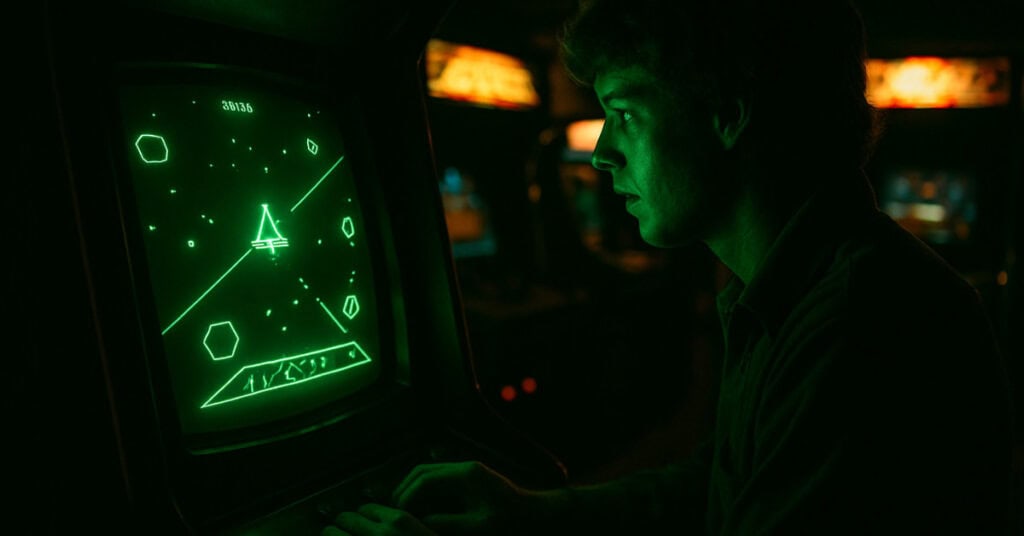
Atari’s space shooter provided hours of entertainment thanks to the vector graphics and inertia-based movement to create a realistic feeling space environment. The “lurking” technique was used by players to maximize their score in what became high score competitions.
4. Galaga’s Space Opera

The sequel to Galaxian was released in 1981 and perfected space shooter games. The sound effects and graphics made the game a classic arcade game. Letting your spaceship get captured by the enemy for a double-fighter bonus became a common tactic.
5. Dragon’s Lair Innovation

The arcade laserdisc technology that debuted in 1983 was able to produce animated sequences of a quality that had never been seen before in the arcade business. The games were 50 cents to play, which was very expensive, but it was an offer that was difficult to refuse. People would want to play over and over again in order to see all of the death animations of Dirk the Daring, and it was also entertaining to see the successes. Crowds would form to watch other players complete the many steps to successfully navigate around the castle.
6. Ms. Pac-Man’s Perfection

The unofficial sequel to the arcade game came out in 1981, and included an improved design that added multiple mazes and higher difficulty levels due to the introduction of more intelligent ghosts. The intermission love story was a nice addition while the improvement of the overall speed of the game made it even more difficult for veterans of Pac-Man even Dot-eating enthusiasts consider it one of the best versions of the franchise.
7. Defender’s Complexity

In 1981, Williams released a side-scrolling shooter that created a whole new level of complexity for arcade gaming. Players had to learn to control the reverse thrust and to time their smart bombs in order to gain mastery. Those who were able to get it right set the bar for arcade gaming. Players also enjoyed the game’s impressive graphics and sound effects.
8. Centipede’s Trackball

The 1981 shooter by Atari was one of the first games to use a trackball control, and it created a new level of gaming experience as players shot mushrooms and insects while dodging a centipede. The gaming experience became increasingly intense as the action continued.
9. Frogger’s Challenge

The 1981 road-crossing game by Konami had players waiting for the right moment to cross, and it taught them the importance of timing. The simple design led to players returning to the game over and over again. The sound of failure was so familiar in arcade games that it became a type of soundtrack.
10. Q*bert’s Innovation

The 1982 isometric puzzle game introduced brand new graphics, and its character design was also new and memorable. When players made Q*Bert angry he would swear, and that became a new form of entertainment. Q*bert also used diagonal controls
11. Space Invaders’ Legacy

The beginning of the golden age of arcades started in 1978 and was caused by the now iconic game of Space Invaders. For each row of aliens descending your ship, the tempo of the game picked its pace, creating a sense of urgency and excitement. While the graphics were simple, players were able to build worlds in their mind. Due to the popularity of Space Invaders, Japanese arcades even experienced coin shortages!
12. Tempest’s 3D World

Atari’s 1981 masterpiece of vector graphics was an early 3D implementation of tube shooting. The game featured unique visuals for each screen, while the spinner control created the game experience and the Superzapper was an emergency escape option.